There are no items in your cart
Add More
Add More
| Item Details | Price | ||
|---|---|---|---|

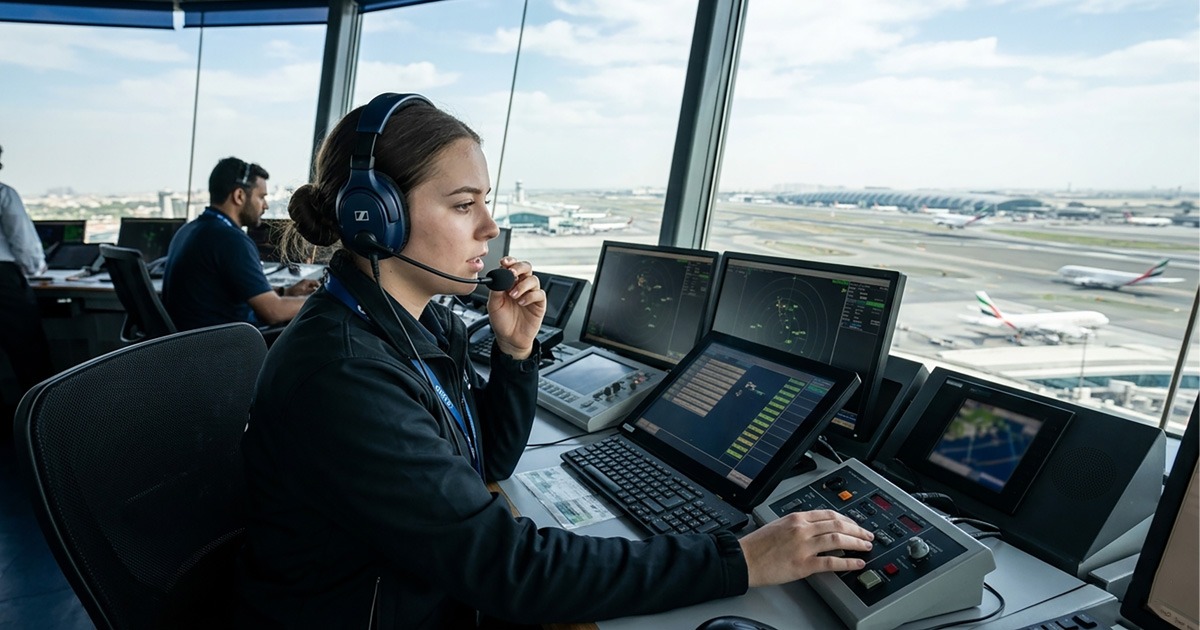
There's a moment every aspiring Air Traffic Controller remembers — the first time they hear a live ATC frequency crackle to life. Dozens of transmissions, one after another, rapid and precise, each word carrying the weight of hundreds of lives. And in that moment, one truth becomes undeniable: in aviation, language is not just communication. It is safety.
For every ATC student standing at the threshold of this career, mastering aviation English isn't optional — it's foundational. Before you can separate traffic, issue clearances, or manage complex airspace, you must first be able to communicate clearly, accurately, and without ambiguity in English. This is not simply a regulatory checkbox. It is the invisible infrastructure that keeps the global aviation system from unraveling.
Whether you're preparing for the ICAO ATC 051 course or just beginning to explore a career in air traffic control, understanding why aviation English is so critical will shape how seriously you approach your training from day one.
Aviation is one of the few industries in the world that operates across every border, timezone, and culture — and yet speaks in a single language. That language is English, as mandated by the International Civil Aviation Organization (ICAO), the United Nations body that governs international civil aviation standards worldwide.
ICAO's language policy didn't emerge arbitrarily. It was born from tragedy. Several high-profile aviation accidents throughout the 20th century — including the 1977 Tenerife disaster, one of the deadliest in aviation history — were either caused or compounded by language misunderstandings on the frequency. When a pilot misinterprets a clearance due to a language gap, the consequences can be catastrophic and irreversible.
This is why ICAO developed its Language Proficiency Requirements (LPR), which assess aviators and controllers across six operational domains: pronunciation, structure, vocabulary, fluency, comprehension, and interactions. These aren't abstract academic criteria — they reflect the real demands of communication in dynamic, high-pressure airspace environments.
To operate internationally, every licensed controller must demonstrate a minimum of ICAO English Level 4 — the Operational Level — with Level 6 being Expert. In the UAE, the General Civil Aviation Authority (GCAA) enforces these requirements rigorously. Controllers who cannot demonstrate proficiency simply cannot be licensed, regardless of their technical knowledge.
This is the landscape every ATC student enters. And it underscores why aviation English training must begin long before technical ATC instruction does. If you want to explore what a structured path into this field looks like, the blog post on ICAO ATC 051 — your gateway to air traffic control is a valuable starting point.
Ask any experienced ATC instructor what separates students who struggle from those who excel in their initial training, and the answer is almost always the same: English proficiency. Not aptitude. Not even general intelligence. English.
The ICAO ATC 051 Basic Induction Course is an intense, technically demanding program. Students are expected to absorb separation standards, airspace classifications, phraseology, strip marking, and procedural logic — all delivered in English, all requiring precise comprehension and immediate application. When a student is simultaneously battling the language and the technical content, both suffer.
Pre-051 English training removes that double burden. It builds the linguistic runway that allows students to focus their cognitive resources on learning ATC technique rather than decoding instructions. More specifically, it prepares students for:
Reading and Comprehension of Technical Documents — ATC training involves constant reading of ICAO documents, PANS-ATM manuals, local procedures, and letters of agreement. Strong technical English reading skills mean students can extract and retain critical information independently.
Listening and Transcription Under Pressure — Aviation communication is often fast, accented, and compressed. Pre-course English training hones the listening skills needed to accurately copy and respond to traffic, even when conditions are less than ideal.
Structured Verbal Expression — Controllers must deliver information clearly, in a specific sequence, without hesitation. English training builds the verbal confidence and structural accuracy this demands.
Writing and Reporting Skills — Incident reports, coordination records, and operational logs must be written in clear, unambiguous English. Students who write well communicate better across every dimension of the job.
If you're currently at the stage of considering your entry into aviation, the guide on how to start a career in aviation after high school in Dubai covers the broader roadmap — including the role English plays in qualifying for foundational courses.
At Air Traffic World (ATW), the Aviation English Communication Course is specifically designed to bridge this gap. It targets the language skills that matter most in aviation contexts, preparing students to walk into their ATC training — and succeed — rather than spending the first weeks catching up linguistically.
If aviation English is the broad language of the skies, radiotelephony (RTF) is its most precise dialect. And for ATC students, mastering RTF isn't simply about sounding professional on the radio — it's about transmitting exactly the right information, in exactly the right format, with zero room for misinterpretation.
RTF and standard phraseology are codified in ICAO Doc 9432 (Manual of Radiotelephony) and reinforced across PANS-ATM (Doc 4444). These aren't suggestions — they're the standardised framework that allows a controller in Dubai and a pilot trained in Tokyo to communicate flawlessly the moment they share a frequency.
Standard phraseology works because it removes ambiguity through precision. Every approved phrase has one meaning. It is structured, predictable, and brief. When you tell a pilot "Cleared to land Runway 30 Left, wind 290 degrees, 12 knots," there is no room for creative interpretation. The message is a technical instruction, not a conversation.
Here's why RTF training deserves serious investment:
Phraseology errors cascade. A controller who says "after landing, take the first..." instead of "after landing, turn right, first right..." creates a chain of ambiguity. The pilot interprets, the aircraft moves, other traffic is affected. Standard phraseology breaks this chain before it begins.
Non-standard language invites readback errors. Pilots are trained to read back clearances and instructions. When controllers use imprecise or non-standard language, readbacks become uncertain, often unchallenged, and sometimes incorrect. The result is an instruction that was never properly confirmed — a condition that has preceded several serious incidents worldwide.
Plain English has its place, but rules apply. ICAO acknowledges that not every situation can be handled with standard phrases alone. In complex, unexpected, or emergency situations, plain English is permitted and even encouraged — but only at ICAO Level 4 or above. Students who aren't proficient enough in English cannot safely shift into plain language when the situation demands it.
Accent and clarity are operational factors. RTF training includes work on clear pronunciation, appropriate speech rate, and microphone technique. A message delivered too quickly, in a heavy or unfamiliar accent, or with poor microphone discipline can be misunderstood even if the phraseology is technically correct. This is why quality aviation English training addresses not just what is said, but how.
For a wider perspective on why mastering communication in aviation matters, the blog master global aviation communication with Air Traffic World provides a compelling read. Additionally, ICAO's own radiotelephony phraseology resources offer an authoritative reference for students who want to go deeper.
There is a direct, well-documented relationship between language proficiency and operational safety in aviation. ICAO's own research, compiled in the development of the Language Proficiency Requirements, found that language-related communication breakdowns were a contributing factor in a significant number of aviation accidents and serious incidents globally.
This isn't about grammar. It's about clarity under pressure.
An air traffic controller's working environment is one of the most cognitively demanding workplaces in the world. You are managing multiple aircraft simultaneously, anticipating conflicts before they develop, coordinating with adjacent sectors, and communicating with flight crews who range from highly experienced veterans to relatively new first officers, from native English speakers to pilots working in their fourth or fifth language. In this environment, your English is your tool. A dull tool causes errors; a sharp one saves lives.
Language proficiency prevents read-back and hear-back errors. Some of the most common precursors to aviation incidents involve a controller issuing an instruction, a pilot reading it back incorrectly, and the controller — due to inattention, workload, or language uncertainty — failing to catch the error. ICAO proficiency standards, particularly in the area of comprehension and interaction, are designed to reduce exactly this failure mode.
Proficiency enables confident correction. Controllers who are uncertain of their English often hesitate to challenge incorrect readbacks or to seek clarification. Proficient controllers correct without hesitation. This seemingly small difference is enormous in practice.
Language proficiency supports better situational awareness. When communication is fluent, mental resources are freed for the actual task of traffic management. Controllers who are linguistically confident process information faster, respond more decisively, and maintain better situational awareness across the entire sector. Conversely, a controller who is linguistically strained experiences cognitive fatigue earlier, which directly compounds the risk of errors.
Proficiency matters most when things go wrong. Standard phraseology handles the routine. But emergencies, unusual situations, and unexpected events require real-time, precise plain language communication — in English. A controller managing a medical emergency, engine failure, or runway incursion needs to express complex, dynamic information instantly and accurately. That is not a skill you develop under pressure — it is one you build long before you ever sit behind a radar screen.
This is why the relationship between language proficiency and topics like safety management systems and fatigue and stress management in aviation is not incidental — they are all part of the same professional foundation. A controller who communicates clearly also manages pressure better, reports accurately, and contributes to a safer safety culture.
For students preparing for their ICAO 051 training in the UAE, meeting the language proficiency requirement isn't a hurdle to clear — it's a skill to genuinely develop. The difference between a controller who barely reaches Level 4 and one who operates comfortably at Level 5 is not a number on a certificate. It is the quality of every transmission they make for the rest of their career.
If you're serious about a career in air traffic control, your English proficiency journey starts now — not after you've enrolled in technical training, and not when a licensing board reminds you it's mandatory.
At Air Traffic World (ATW), the Aviation English Communication Course is tailored specifically for aviation professionals and aspiring ATC students. It covers ICAO language proficiency requirements, standard phraseology, RTF communication, and the real-world English skills demanded by the most safety-critical workplaces on earth — right here in Dubai.
Don't wait until language becomes the obstacle standing between you and your licence. Make it the foundation your entire aviation career is built on.
Explore the Aviation English Communication Course or get in touch with our team to find out how ATW can help you meet — and exceed — ICAO's language proficiency standards.
Tags: Aviation English course Dubai, ICAO English proficiency, RTF training, aviation communication skills