There are no items in your cart
Add More
Add More
| Item Details | Price | ||
|---|---|---|---|

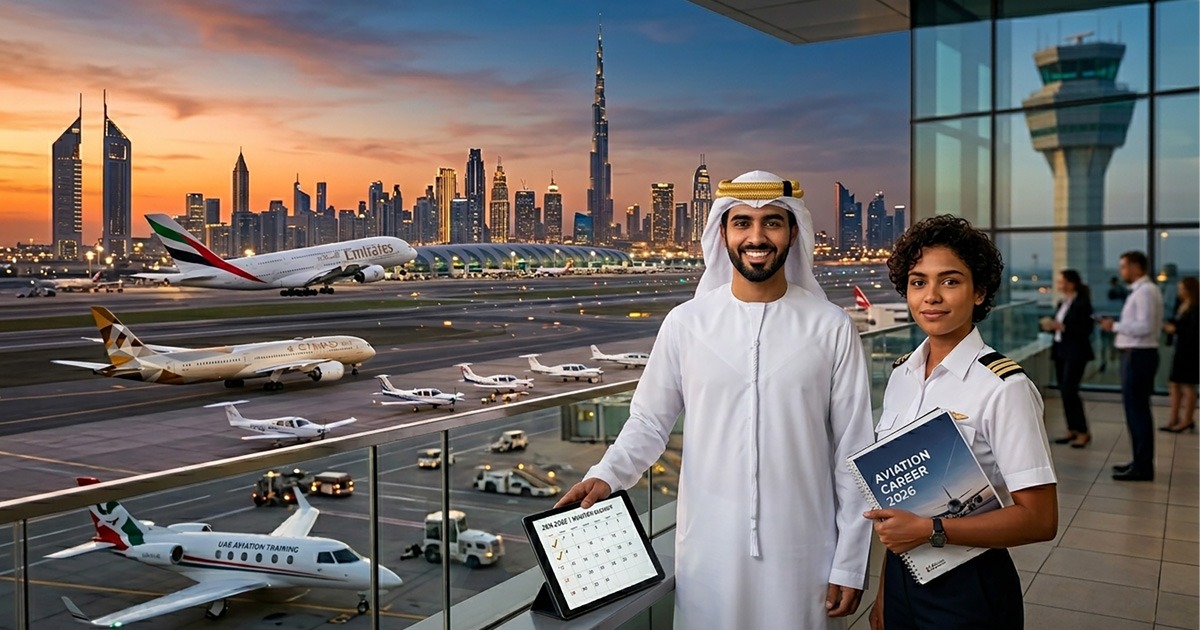
If you have ever considered a career in aviation — as an air traffic controller, cabin crew trainer, aviation safety specialist, or aviation English instructor — you have likely been waiting for the "right time." That time is not coming. It has already arrived. The UAE's aviation sector is entering one of the most significant growth phases in its history, and the professionals who position themselves now will be the ones shaping its future. Let's break down exactly why 2026 is the year you act.
The Dubai Economic Agenda D33 is not a vague vision statement — it is a meticulously engineered blueprint to double Dubai's GDP over the next decade and cement the emirate's position as one of the world's top three economic hubs. Officially launched by His Highness Sheikh Mohammed bin Rashid Al Maktoum, the D33 agenda targets AED 32 trillion in cumulative trade over ten years and aims to attract 650 top global companies to establish regional headquarters in Dubai. Aviation is its structural backbone.
Under D33, aviation is explicitly identified as one of the twelve strategic sectors driving Dubai's economic transformation. The plan calls for accelerated investment in airport infrastructure, aviation logistics, cargo capacity, and — critically — human capital development. This last point matters enormously for anyone considering an aviation career: the UAE government has tied budgetary commitments directly to building a workforce that can support this expansion. Institutions offering GCAA-approved aviation courses in Dubai are therefore operating in a policy environment that is actively supportive, not merely permissive. ICAO ATC 051 Basic Induction Course
Beyond raw numbers, D33 carries a profound cultural signal: the UAE is serious about retaining and growing local aviation talent. The Emiratisation drive within the aviation sector means that airlines, airports, and aviation service providers are under active incentive to hire and develop UAE-based professionals. If you are completing a certified qualification in 2026, you are not entering a neutral jobs market — you are entering one that has been structurally engineered in your favour.
The D33 agenda also places significant emphasis on the knowledge economy, which translates directly into demand for high-quality aviation training institutions. As airlines and air navigation service providers race to meet expansion targets, the need for aviation English communication training, safety management system (SMS) courses, and advanced instructor qualifications is accelerating in lockstep with physical infrastructure growth. This isn't coincidence — it's policy design.
If D33 is the economic engine, then Al Maktoum International Airport (DWC) is the physical embodiment of Dubai's aviation ambition. The airport — located in Dubai South — is currently undergoing one of the most audacious airport expansion projects in human history. The phased construction plan will ultimately give DWC a capacity of 260 million passengers per year, making it the largest airport on earth by a significant margin.
To put this in perspective: London Heathrow, one of the world's busiest airports, currently handles approximately 80 million passengers annually. DWC's completed vision is more than three times that scale, operating from a single mega-site. The first major phase — targeting 150 million passengers — is projected to be operational within the next few years, with construction contracts and workforce mobilisation already well underway.
Every 10 million additional passenger movements at a major international airport generates an estimated 1,000+ direct aviation jobs — air traffic controllers, safety officers, ground operations specialists, airline trainers, and security personnel among them. DWC alone is expected to catalyse tens of thousands of new aviation-sector positions in the UAE. Add the continued growth of Dubai International Airport (DXB) and Abu Dhabi International Airport, and the UAE aviation job market in 2026 and beyond is structurally undersupplied with qualified professionals. This gap is your opportunity. Enrolling now means qualifying at the exact moment when demand for trained professionals peaks.
The construction and operational ramp-up at DWC is also directly stimulating adjacent sectors: MRO (Maintenance, Repair & Overhaul) facilities, cargo logistics hubs, aviation fuel infrastructure, and pilot training academies are all scaling up in the Dubai South ecosystem. Dubai South itself has been designated a free zone, which simplifies establishment for international aviation businesses — and each one of those businesses needs trained personnel from day one.
There is also a knock-on effect on air traffic control staffing. As DWC opens new runways and additional airspace sectors are activated, the UAE General Civil Aviation Authority (GCAA) will require a significantly expanded pool of qualified Air Traffic Control Officers (ATCOs). Courses like the ICAO ATC 051 Basic Induction course — which meets ICAO Annex 1 standards — are the recognised entry pathway for this career in the UAE.
For professionals already working in aviation — trainers, safety managers, cabin crew supervisors — the DWC expansion also represents an extraordinary opportunity to step into senior roles at one of the world's most high-profile new aviation hubs. If your qualifications are current and GCAA-recognised, you will be among the first considered.
Aviation has always been technology-led. But 2026 marks a turning point where artificial intelligence, autonomous systems, and advanced air mobility (AAM) are moving from experimental phases into active regulatory frameworks. Far from replacing human professionals, these shifts are creating an urgent need for a new generation of technically literate aviation specialists who understand both the human and machine dimensions of flight.
Urban Air Mobility (UAM) is perhaps the most visible symbol of this shift in the UAE context. Dubai's Roads and Transport Authority (RTA) has been actively trialling autonomous air taxi services, and the emirate has set ambitious targets for integrating aerial vehicles into its public transport infrastructure. The International Civil Aviation Organization (ICAO) has been developing dedicated frameworks for UAM operations, and the UAE's GCAA is among the most forward-leaning regulators in translating those frameworks into local licensing and airspace management rules. ICAO – International Civil Aviation Organization
Here is how the technology shift is playing out across specific aviation disciplines:
The pattern is consistent: technology amplifies the need for well-trained humans — it does not eliminate it. The professionals who will thrive in the AI-augmented aviation sector are those who combine deep technical knowledge with strong human skills: communication, judgement, leadership, and the ability to manage complex real-world systems. These are precisely the competencies that structured aviation courses are designed to build.
There's also a fatigue and stress management dimension to this technological shift that is often overlooked. As AI tools speed up operational tempo and reduce some cognitive tasks, they simultaneously intensify others — requiring aviation professionals to manage a more complex blend of automated and manual responsibilities.
Regulators worldwide — including the GCAA and ICAO — are also revising training curricula to include AI literacy components. Earning your aviation qualifications in 2026 means you will graduate with syllabuses that already reflect these emerging standards, giving you a head start over professionals trained under older frameworks.
Across global aviation, the post-pandemic recovery has revealed a structural truth that was already developing before COVID-19 disrupted everything: the pipeline of qualified aviation professionals was never deep enough to meet long-term growth projections. The pandemic-era mass redundancies and early retirements accelerated this shortage dramatically, and the UAE — with its exceptionally ambitious expansion plans — is among the most acutely affected markets.
According to IATA (International Air Transport Association) forecasting, the global aviation industry will need to recruit and train approximately 600,000 additional pilots, 900,000 maintenance technicians, and over 1 million cabin crew over the next two decades to keep pace with traffic growth. In the UAE specifically, the shortage is concentrated not just in cockpit and technical roles but in specialist training, safety management, and air traffic control — precisely the areas where certified professional development matters most.
IATA – International Air Transport Association
Within the UAE, several shortage areas are particularly acute right now.
Air Traffic Control Officers are in high demand as airspace complexity increases ahead of DWC operations. The ICAO ATC 051 course is the recognised entry pathway for this role in the UAE.
ICAO Air Traffic Control Basic Induction Training Blog
Aviation security professionals represent another critical shortage area. As airport footprints grow and the threat landscape evolves, there is sustained demand for personnel holding qualifications in close protection, air marshal operations, and cabin crew violence and aggression management.
Certified aviation trainers are also in short supply. As airlines and aviation service organisations scale rapidly, they need internal instructors who meet international standards — not just subject-matter experts who happen to stand in front of a room. Holding a CPD-accredited Train the Trainer qualification or a Train the Trainer Refresher certification elevates a practitioner's employability and earning potential considerably.
Finally, the shortage extends to professionals with recognised Aviation English Language Proficiency credentials. ICAO mandates Level 4 English proficiency for all pilots and air traffic controllers operating in international airspace, and the GCAA enforces this requirement strictly. With the UAE's multilingual workforce, qualified ICAO English language training providers in Dubai are in exceptional demand — and professionals who complete this requirement gain immediate, regulatory-backed competitive advantage.
The workforce shortages described above create a very specific kind of opportunity: the professionals who qualify before the shortage peaks command premium positions, better salaries, and faster career progression than those who join a saturated market years later. The UAE's aviation sector is not yet at the point of saturation — it is at the point of maximum opportunity. Enrolling in a certified aviation course in 2026 positions you at precisely the right point on that curve.
The four forces described in this article — the D33 economic agenda, the DWC mega-expansion, the technological transformation of airspace operations, and the structural shortage of specialist aviation professionals — are not independent trends. They are converging simultaneously to create a once-in-a-generation environment for aviation career development in the UAE.
Waiting for "more certainty" is itself a decision — and it is one that will cost you positioning in an accelerating market. The professionals and organisations investing in aviation qualifications now will be the ones holding premium credentials when DWC reaches operational scale, when AI-augmented ATC tools go live, and when the D33 agenda enters its highest-growth phase.
At ATW Aviation, we offer a complete portfolio of GCAA-compliant and internationally accredited aviation training programmes — from air traffic control fundamentals to advanced safety management, from aviation English communication to cabin crew security and restraint. Our courses are built for the UAE's aviation future, not its past.
Explore our aviation insights blog for more expert perspectives, or browse our full course catalogue. When you're ready to talk, our team is available and ready to guide you to the right programme.
The skies over the UAE have never been more open. Your career in them starts with a single enrolment decision.
Tags: UAE aviation trends 2026, Dubai airport expansion, aviation job market UAE, future of flight Dubai, GCAA approved courses Dubai, ICAO 051 ATC course, aviation training institute UAE, aviation English communication, Train the Trainer aviation, safety management system aviation