There are no items in your cart
Add More
Add More
| Item Details | Price | ||
|---|---|---|---|

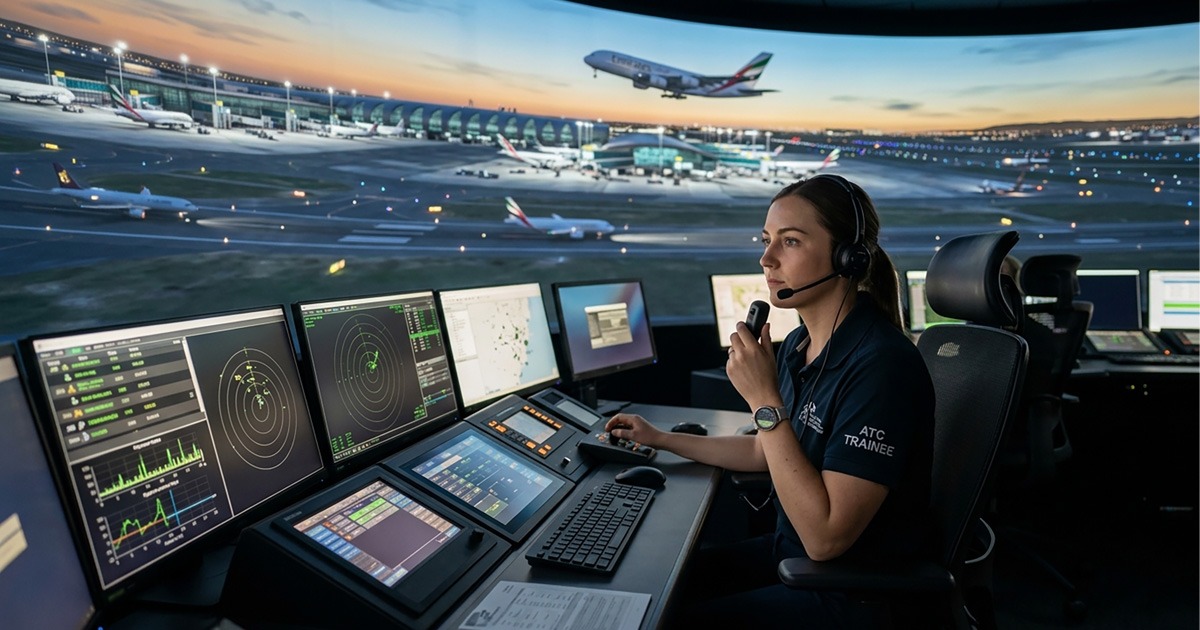
There is a moment every Air Traffic Controller remembers — the first time they sat in a live control position and realised that the aircraft on that radar screen were not dots on a computer. They were real machines, carrying real people, and every instruction they gave mattered.
That moment used to arrive with almost no preparation. Controllers would absorb months of theory, pass written examinations, and then find themselves in the hot seat with barely a lived experience to draw from. The consequences of learning on the job in a live operational environment were simply too serious — and the aviation industry knew it had to find a better way.
That better way is simulation. And not the basic, flat-screen kind. We are talking about full-immersion 3D tower simulation — the gold standard in modern ATC training that is rapidly becoming not just recommended, but non-negotiable for anyone serious about building a competent, confident air traffic controller.
At Air Traffic World (ATW), we have built our practical training programme around exactly this principle. Here is why simulation-based learning is transforming aviation training — and why the 3D tower environment is at the heart of it all.
Ask any experienced aviation educator about the biggest challenge in producing job-ready controllers, and they will tell you the same thing: the gap between theoretical knowledge and operational competence is enormous.
A student can understand the principles of radar separation in a classroom. They can recite ICAO phraseology correctly in a written test. They can diagram the structure of controlled airspace on a whiteboard. But understanding about ATC and being able to do ATC under real-time pressure are two profoundly different things.
This is the gap that ATC simulator training was designed to close.
A well-designed 3D tower simulation recreates the visual environment of an actual control tower — the panoramic view of the apron, the taxiways, the runways, the aircraft moving in real time. The student instructor communicates using authentic radiotelephony, issues real clearances, and manages actual simulated traffic flows. The environment responds. The aircraft respond. And the student responds — building the instinctive, procedural fluency that can only come from doing, not from reading.
This kind of aviation practical training creates what psychologists call procedural memory — the kind of deep, automatic competence that allows a controller to manage five aircraft simultaneously while calmly working through a communication loop with a sixth. It is the same mechanism that allows an experienced driver to navigate a motorway intersection without consciously thinking about every mirror check. You do not think your way through it. You have trained your way through it.
In the UAE, where airspace complexity is among the highest in the world, this level of ingrained competence is not optional. Dubai International Airport alone handles over 1,200 aircraft movements on a peak day. The controllers guiding those movements were not born with the ability to manage that traffic. They built it — through simulation, repetition, and progressive exposure to increasingly complex traffic scenarios.
If you are exploring a career in ATC, understanding the full pathway from training to operation is essential. Our blog on Step-by-Step Roadmap: Becoming an ATC Officer in the UAE provides a detailed breakdown of what that journey looks like.
Here is a question worth sitting with: how do you train someone to handle a runway incursion — without endangering a single aircraft or person?
The answer, for decades, was that you largely could not. Emergency and abnormal situations were covered in briefings, discussed in debriefs, and occasionally walked through in tabletop exercises. But the visceral experience of managing a real emergency — the radio congestion, the rapidly degrading timeline, the competing demands from multiple aircraft simultaneously — that was something controllers only encountered for the first time in actual operation.
Modern 3D tower simulation has fundamentally changed this.
Today's simulators can inject any scenario at any moment — a MAYDAY call from a departing aircraft, a runway incursion by a vehicle, a sudden deterioration in visibility, a loss of communication with an inbound flight. The simulated environment responds with complete realism. The student has to respond in real time, applying correct procedures under genuine cognitive pressure.
This is not a minor training enhancement. This is a transformation in safety culture. Research consistently shows that people who have practiced emergency procedures under realistic conditions perform significantly better when those situations occur in real operations. Muscle memory, decision-making patterns, and communication habits formed in simulation carry directly across to live environments.
For those enrolled in or considering our ICAO ATC 051 On-Site Course, simulation-based emergency training is a cornerstone of the practical component. Students do not just learn what to do in an emergency. They practice doing it — repeatedly, in varied scenarios, until the response becomes second nature.
The psychological dimension matters enormously here too. Controllers who have experienced simulated emergencies carry a kind of trained composure into live operations. They have already felt the spike of adrenaline. They have already worked through the instinct to freeze or over-correct. By the time they encounter a real abnormal situation, they are drawing on experience — not facing a blank page.
For deeper insight into how psychology underpins ATC performance, our recent blog on Human Factors: The Psychology of Safe Air Traffic Management explores exactly these dynamics.
There is a reason ATW has structured its simulation component as a concentrated, intensive block — and it is not administrative convenience. The science of skill acquisition is clear: massed, immersive practice within a defined period produces faster, deeper learning than the same number of hours spread thinly across months.
Ten days of intensive flight simulator Dubai training creates a learning environment that mirrors, as closely as possible, the genuine operational tempo of a real control tower. Students arrive in the morning. They brief. They simulate. They debrief. They brief again. The rhythm of operational life is built into the training day itself.
What does ten days of intensive simulation actually look like in practice?
It begins with orientation — familiarisation with the simulated environment, the console layout, the visual scanning patterns required in tower operations. From there, traffic complexity builds incrementally. In the early sessions, students manage light, predictable traffic in good visual conditions. By the midpoint of the programme, they are handling mixed traffic, conflicting clearances, and weather variables. In the final days, they face complex multi-aircraft scenarios with injected abnormalities — the kinds of situations that test everything they have absorbed.
Each session is followed by a structured debrief. Instructors replay specific moments from the simulation, analyse decisions, identify communication patterns, and highlight both errors and examples of strong instinctive judgement. This feedback loop is essential. It transforms raw experience into integrated learning.
The intensity of this format also builds something that extended, low-frequency training cannot: mental stamina. Managing complex airspace is cognitively demanding in a way that few other professions can match. Sustained concentration, simultaneous processing of multiple information streams, and decisive real-time communication under pressure are all core ATC competencies. They are also skills that must be practised under genuine cognitive load to develop properly. An intensive ten-day block creates that load in a way that weekly two-hour sessions simply cannot replicate.
Students who complete intensive simulation blocks consistently report a qualitative shift in their confidence and fluency — not just familiarity with procedures, but an internalised, embodied sense of knowing what to do. That shift is the whole point.
The economic case for simulation-based training is, by now, overwhelming — and it deserves to be stated clearly, because it directly affects access and opportunity for the next generation of aviation professionals.
Traditional live training in ATC contexts requires access to operational facilities, qualified on-the-job training instructors, a manageable live traffic environment, and an extended placement period during which the trainee is, by definition, a supervised risk. All of this is expensive. The total cost of producing a job-ready controller through traditional means — accounting for facility costs, instructor time, extended training periods, and the operational inefficiencies of supervised live training — runs into tens of thousands of dirhams per candidate.
3D tower simulation compresses this dramatically.
A single simulation suite can run multiple scenarios per day, with multiple student positions simultaneously active. Scenarios can be repeated immediately — something impossible in live training. Instructors can pause, rewind, and replay events that would, in live operations, be gone in seconds. The result is a higher density of learning per training hour, and a significantly shorter pathway from zero to operational readiness.
The data on success rates is equally compelling. Candidates who complete structured simulation programmes before entering live OJT (On the Job Training) demonstrate higher first-time pass rates on operational competence assessments, lower error rates in early supervised operation, and faster progression to unsupervised operational status. They also report lower anxiety levels and higher job satisfaction in their early operational years — a factor that matters for long-term retention in a profession where experienced controllers are a genuinely scarce resource.
For institutions and national aviation authorities, simulation-based training is therefore not just a pedagogical preference — it is a workforce strategy. Producing more competent controllers, more quickly, at lower cost per candidate, is a strategic imperative for any aviation ecosystem that wants to grow.
It is also worth noting that simulation training aligns with the direction of travel in GCAA-approved aviation courses in Dubai, where evidence-based, competency-verified training is increasingly the regulatory expectation rather than a differentiator. Understanding the regulatory landscape — who approves what, and why — is essential reading for any serious candidate or institution.
At Air Traffic World, our commitment to simulation-based training is not a marketing claim. It is built into the structure of every practical course we offer.
Our ICAO ATC 051 course combines the theoretical rigour required by ICAO standards with hands-on 3D simulator time that translates knowledge into operational competence. Our instructors are experienced ATC professionals — people who have sat in live control positions and understand, from direct experience, what the simulator must prepare students for.
We also recognise that ATC performance does not exist in isolation. It is connected to communication skill, fatigue management, human factors awareness, and the broader safety culture of an organisation. That is why our course portfolio extends across aviation fatigue and stress management, aviation English communication, and safety management systems — because great controllers are more than technically proficient. They are communicators, decision-makers, and professionals who carry safety as a core value.
Our blog on ICAO Air Traffic Control Basic Induction Training provides a useful overview of how foundational ATC training is structured and what candidates can expect from a quality programme.
Aviation has always been an industry where the cost of unpreparedness is measured not in money, but in lives. The evolution of 3D tower simulation is, at its core, a response to that reality — a commitment by the aviation training community to ensure that no controller ever stands at a live position without having already stood there, in simulation, many times before.
The gap between theory and practice is real. The risks of emergency situations are real. The cost of inadequate training is real. And the solution — structured, immersive, progressive ATC simulator training — is available right now, in Dubai, for those ready to invest in the kind of preparation that the profession demands.
The sky does not wait for the unprepared. But the right training ensures you are ready when it calls.
Ready to begin your ATC training journey? Explore our full course catalogue or contact our team to learn more about our simulation-based programmes in Dubai.