There are no items in your cart
Add More
Add More
| Item Details | Price | ||
|---|---|---|---|

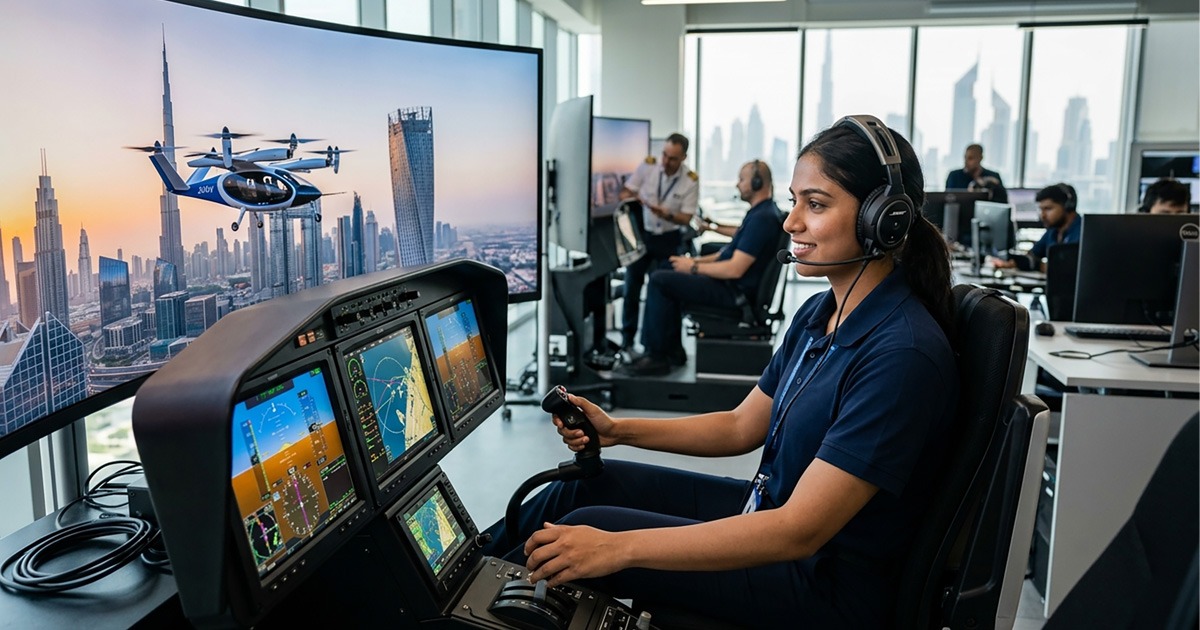
Imagine stepping out of a downtown Dubai hotel, tapping an app, and boarding an air taxi that carries you silently above the skyline — gliding past the Burj Khalifa, over the Creek, and landing at Dubai International Airport in under ten minutes. No gridlock. No delays. No road rage.
This is not science fiction. It is the plan — and it is happening now.
Dubai has staked its reputation on being a city that does not wait for the future. It shapes it. With the Roads and Transport Authority (RTA) already in advanced talks with eVTOL (electric Vertical Takeoff and Landing) manufacturers and Urban Air Mobility (UAM) operators, the emirate is positioning itself as the world's first major city to commercially launch air taxis at scale. The target? 2026.
But here is the question that rarely makes the headlines: Who is going to manage all of this?
Every aircraft needs a pilot or operator. Every new airspace needs controllers. Every new passenger category needs safety-trained crew. Every new aircraft type needs certified instructors. The air taxi revolution is not just a technology story — it is a workforce story. And in aviation, the workforce story always begins with training.
Before a single air taxi lifts off commercially in Dubai, the city needs something that does not exist anywhere at scale yet: vertiports.
A vertiport is to an air taxi what an airport is to a commercial airliner — but reimagined for the urban environment. Think rooftop landing pads integrated into skyscrapers, elevated platforms at metro stations, and purpose-built hubs at key destinations like Dubai Mall, Palm Jumeirah, and Expo City.
The UAE's General Civil Aviation Authority (GCAA) is working to build a regulatory and infrastructure framework that allows these facilities to operate safely alongside existing aviation traffic. This is no small feat. Vertiports introduce a host of new safety, maintenance, and operational considerations that simply do not exist in traditional aviation:
Aviation professionals who understand Safety Management Systems (SMS) and can apply structured hazard identification to these novel environments will be extraordinarily valuable in the years ahead. ATW Aviation's Safety Management System course provides exactly this foundational knowledge — covering risk assessment frameworks and safety culture principles that translate directly into UAM environments.
Traditional air traffic control was designed for a world of fixed-wing aircraft operating at altitude, following defined airways, served by radar systems and standardized procedures developed over decades. Urban air mobility blows up most of those assumptions.
eVTOLs will fly at altitudes between 150 and 600 metres — below the radar coverage typically used for commercial aviation, above the buildings that block line-of-sight communication, and in corridors that overlap with drones, helicopters, police aircraft, and emergency services. Managing this environment requires a fundamentally different approach.
Enter UTM — Unmanned Traffic Management — and its manned equivalent, Advanced Air Mobility Traffic Management. These systems rely on digital, data-driven airspace management rather than traditional radar and voice communication. Controllers in this space will need to:
This last point is critical. Aviation English and radiotelephony communication skills will remain essential even as technology evolves. ICAO's language proficiency requirements do not disappear simply because aircraft become electric. If anything, the density and speed of UAM communication will demand higher standards of clarity, precision, and phraseology discipline.
ATW Aviation's Aviation English Communication course is already helping aviation professionals across the UAE meet ICAO Level 4 and above — the benchmark that regulators globally will expect of anyone communicating in UAM airspace. You can also explore the broader topic of ICAO language proficiency in this published guide: Master Global Aviation Communication with Air Traffic World.
For those interested in the foundational air traffic control skills that low-altitude UAM management will build upon, ATW Aviation's ICAO ATC 051 Basic Induction Training remains a critical first step — and a deep dive into what the course requires can be found here: ICAO 051 Course Requirements, Benefits and Why It Matters.
The aviation jobs that will be in highest demand by 2026 and beyond are roles that, in many cases, barely exist today. Here is what the industry is already beginning to define:
Unlike traditional commercial pilots who complete thousands of hours of flight training on complex manual aircraft, eVTOL operators will be trained on highly automated systems that handle much of the flight envelope autonomously. The human role shifts from manual flight to mission management, systems monitoring, and emergency decision-making.
This changes what training looks like. Human Factors — the science of how human cognition interacts with automated systems — will be front and centre. Fatigue and stress management become paramount when an operator is overseeing multiple simultaneous urban flight paths with minimal manual input but maximum consequence for errors.
ATW Aviation's Fatigue and Stress Management in Aviation course addresses these challenges head-on, preparing aviation professionals to remain mentally sharp and operationally effective in high-pressure, safety-critical roles.
Urban air taxis will carry passengers — and passengers bring unpredictability. In a compact eVTOL cabin with no traditional cabin crew buffer zone, managing passenger behaviour, medical incidents, and emergency evacuations will require specialised training.
Relevant skills include:
The ATW Aviation blog on Aircraft Evacuation Management covers key principles that apply directly to novel aircraft types. For practical cabin safety skills, the Cabin Crew PMVA Self-Defence and Restraint Methods course equips crew with the practical tools to manage challenging in-flight behaviour with confidence.
Perhaps the most urgent need of all is for qualified aviation instructors who can train others in UAM operations. As new roles emerge, someone has to build the curricula, write the assessment frameworks, and stand in front of the classroom — or the virtual training environment — and deliver that knowledge effectively.
The demand for Train the Trainer qualified aviation professionals will spike significantly as UAE airlines, helicopter operators, and new UAM companies scramble to onboard and certify their workforces before 2026.
ATW Aviation's Train the Trainer course is designed for exactly this moment — equipping aviation subject matter experts with the instructional design, facilitation, and assessment skills they need to build the next generation of UAM professionals. Read more on this topic here: Train the Trainer in Aviation.
Dubai's air taxi revolution is not a distant horizon event. The RTA's agreements with operators like Joby Aviation and Skyports Infrastructure, the GCAA's developing UAM regulatory framework, and the city's track record of executing ambitious infrastructure projects on time all point to one reality: the clock is ticking.
At ATW Aviation, we have always believed that the best way to prepare for the future of aviation is to master the fundamentals that every future innovation is built on. Every eVTOL pilot will need to understand airspace. Every UAM controller will need to communicate precisely. Every air taxi safety officer will need to apply structured risk assessment. Every UAM instructor will need to teach effectively.
These are not new skills. They are timeless aviation competencies — and they are exactly what we teach.
Here is how ATW Aviation is positioning professionals for the UAM era:
Foundation-Level Training The ICAO ATC Basic Induction (051) course gives aspiring air traffic and UAM traffic professionals the ICAO-aligned foundation that regulators will require. This is the starting point — not just for traditional ATC, but for anyone who will work in managed airspace, including low-altitude UAM corridors.
Aviation English and Communication ICAO English Level 4 is not optional in any airspace. The Aviation English Communication course builds the radiotelephony and phraseology skills that UAM roles will require, and prepares candidates for ICAO language proficiency assessments. More detail on English language proficiency in Dubai is available on the ATW blog.
Safety and Risk Management The Safety Management System course equips professionals with the SMS competencies that vertiport operators, UAM airlines, and regulators will demand — including hazard identification, risk assessment, and safety performance monitoring. For a broader picture of how safety principles apply across aviation, visit the ATW blog post on Safety and Emergency Procedures.
Human Performance and Wellbeing UAM operations will demand sustained concentration and rapid decision-making in novel, high-density environments. The Fatigue and Stress Management in Aviation course ensures professionals understand how to manage their own performance — a prerequisite for anyone operating in safety-critical UAM roles. Aviation physiology and human performance are also explored in the ATW post on Physiotherapy in Aviation.
Instructor Development The Train the Trainer course and the Train the Trainer Refresher ensure that the professionals building UAM training programmes are equipped to do so to ICAO and CPD-accredited standards.
The air taxi revolution will create jobs. It will also obsolete the careers of those who do not adapt. The professionals who thrive in Dubai's 2026 UAM landscape will be those who started their training now — not after the vertiports open and every employer in the city is competing for the same scarce certified talent.
The window to build your UAM-ready credentials is open. The question is whether you will step through it.
Browse all ATW Aviation courses and take the first step toward a career that is built for aviation's next chapter. If you have questions about which pathway is right for your background and ambitions, contact the ATW Aviation team — we are here to help you map your route.
The future of Dubai's sky is being written. Make sure your name is in it.
Air Traffic World (ATW) Aviation is a GCAA TO 105 approved aviation training institute based in Dubai, UAE, delivering ICAO-compliant courses for aviation professionals across the Middle East and beyond.