There are no items in your cart
Add More
Add More
| Item Details | Price | ||
|---|---|---|---|

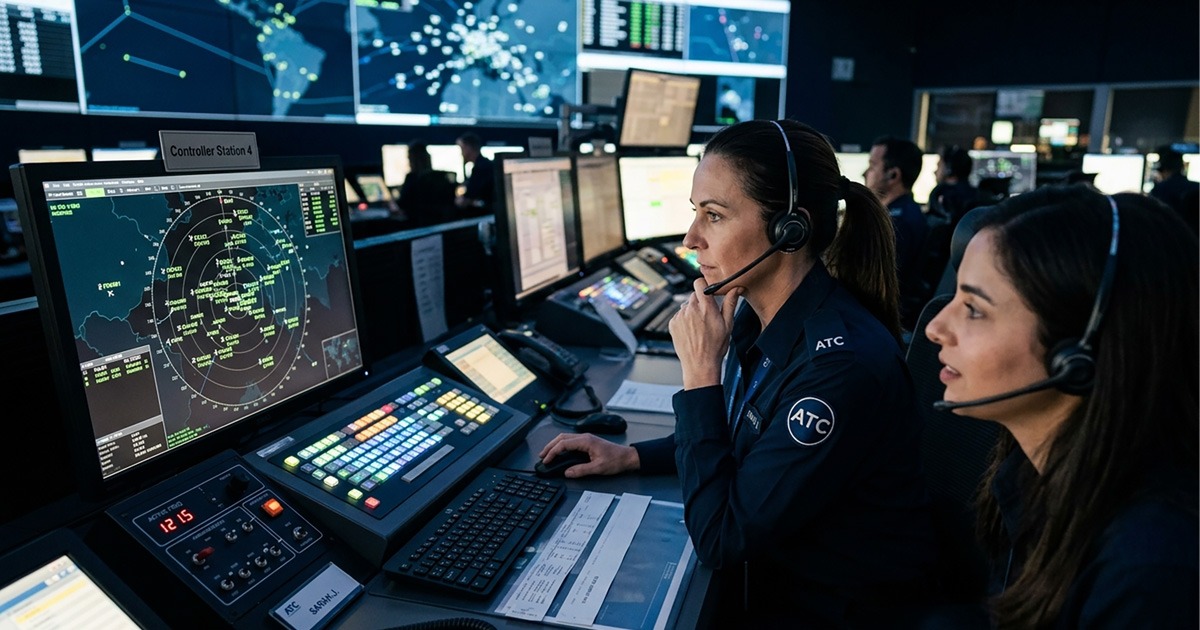
There's a phrase that aviation professionals repeat so often it has almost become a reflex: "Aviation is the safest form of travel." And statistically, it's true. But behind that reassuring statistic is a relentless, ongoing effort — one that goes far beyond radar screens, checklists, and aircraft maintenance logs.
The most critical variable in aviation safety has never been hardware. It has always been the human being behind the controls, behind the microphone, behind the glass in the tower.
Human factors in aviation is the discipline that takes this reality seriously. It asks the uncomfortable question: What happens when a trained, qualified professional makes a mistake? And more importantly — what can we do to prevent it?
At Air Traffic World (ATW), we've built our training philosophy around the understanding that safety is inseparable from psychology. The pressures of managing live airspace, the cognitive demands of rapid-fire decision-making, and the physiological toll of rotating shift work don't disappear when you pass your licensing exam. They intensify. This blog explores how the aviation industry understands and addresses those pressures — and why every professional in the sector needs to know this.
The term "Dirty Dozen" was first introduced by Gordon Dupont of Transport Canada in the early 1990s. It identified twelve of the most common human factors that contribute to aviation accidents and incidents. Decades later, the framework remains one of the most practical diagnostic tools in the industry.
Here are the twelve culprits — and why they matter in the context of air traffic management:
1. Lack of Communication Miscommunication between controllers and pilots, or between shift personnel during handovers, is one of the most frequent precursors to near-misses. Ambiguous phraseology, assumptions, and incomplete readbacks create gaps where errors live. Aviation English communication training directly addresses this — not as a language exercise, but as a safety intervention.
2. Complacency Experienced professionals are paradoxically among the most vulnerable. When routine tasks feel automatic, vigilance erodes. The antidote isn't alarm — it's structured situational awareness training.
3. Lack of Knowledge The aviation environment is continuously evolving. New procedures, updated regulations, changes to airspace classifications — staying current isn't optional. Our ICAO ATC 051 On-Site training ensures foundational and advanced knowledge remains operationally sharp.
4. Distraction A momentary shift in attention is all it takes. Distractions in the tower or cockpit can range from a colleague's conversation to an unexpected notification. Managing attention is a trainable skill.
5. Lack of Teamwork Air traffic management is never a solo operation. Controllers, supervisors, flight crews, and ground staff form an interconnected web. When one link weakens, the chain becomes vulnerable.
6. Fatigue We'll address this in detail in the next section — but suffice it to say, fatigue is not merely tiredness. It is a cognitive impairment with measurable, dangerous effects on decision-making and reaction time.
7. Lack of Resources Understaffing, equipment limitations, and inadequate support systems create conditions where professionals are forced to operate outside their optimal capacity.
8. Pressure Whether from time constraints, management expectations, or traffic volume, pressure distorts judgment. Training for high-pressure performance is fundamentally different from training for routine operations.
9. Lack of Assertiveness When a junior controller hesitates to question a senior's decision, or a flight crew fails to challenge an instruction that seems incorrect, the consequences can be catastrophic. Psychological safety in the workplace is not a luxury — it is an operational requirement.
10. Stress Acute stress sharpens focus. Chronic stress degrades it. The distinction matters, and our Fatigue and Stress Management in Aviation course is designed to help professionals identify, manage, and mitigate both forms.
11. Lack of Awareness Situational awareness — the ability to perceive, comprehend, and project the state of a dynamic environment — is the cornerstone of safe air traffic management. Losing it, even briefly, is referred to as "losing the picture." It is one of the most dangerous states a controller can enter.
12. Norms Shortcuts and workarounds that become normalized over time are among the most insidious safety threats. When deviation from standard procedure becomes standard, the margin for error collapses.
Understanding these twelve factors isn't an academic exercise. It is the foundational step toward building a practice of human factors awareness that protects lives every single day.
Sleep is not a lifestyle preference. For air traffic controllers and flight crew, it is a professional competency.
Research from the International Civil Aviation Organization (ICAO) and aviation safety bodies around the world consistently identifies fatigue as a contributing factor in a significant percentage of aviation accidents. The challenge is that fatigue, unlike alcohol or drug impairment, is invisible on standard medical screenings. And unlike pain or nausea, it doesn't always announce itself clearly to the person experiencing it.
Here's what the research tells us about fatigue in air traffic management:
Effective fatigue risk management (FRM) in aviation requires a systemic approach — not simply asking professionals to "get more sleep." At the organizational level, it means:
At the individual level, it means equipping professionals with the self-awareness and coping tools to recognize when they are operating at diminished capacity — and the confidence to say so.
The Fatigue and Stress Management in Aviation programme at ATW is designed to address both dimensions. Drawing on current aviation psychology research and ICAO guidance, the course helps controllers and crew understand their own physiology, build sustainable habits, and contribute to a culture where fatigue is managed rather than masked.
You can also explore more about aviation safety fundamentals in our blog post on Safety and Emergency Procedures — a resource that covers the broader operational safety landscape.
Here is the fundamental paradox of high-stakes decision-making: the conditions that demand the highest quality decisions are the same conditions that most severely degrade our cognitive capacity to make them.
Pressure. Time constraint. Uncertainty. High consequence. These are the four hallmarks of the most critical moments in air traffic management. And they are also, neurologically speaking, exactly the conditions under which the human brain is most likely to default to shortcuts, fall back on incomplete information, and narrow its focus in ways that exclude critical data.
This is not a character flaw. It is human physiology. Understanding it is the first step to overcoming it.
The Role of Cognitive Workload
Cognitive workload refers to the mental effort required to process information and make decisions. In air traffic management, it fluctuates constantly. During a quiet period, workload is low and boredom can itself become a safety risk (linking back to complacency). During peak traffic periods, workload can exceed operational capacity — a state known as cognitive overload.
In overload conditions, controllers are at greatest risk of:
How Aviation Trains for Pressure
The answer is not simply to train harder or longer. It is to train smarter — using methodologies specifically designed to build cognitive resilience under stress.
Key elements of effective pressure training include:
Scenario-Based Training (SBT): Rather than abstract exercises, SBT places trainees in high-fidelity simulations of real operational environments with genuine complexity and consequence. When the scenario feels real, the stress response is authentic — and the learning translates.
Crew Resource Management (CRM): Originally developed for flight deck crews and now widely applied across aviation, CRM training focuses on the non-technical skills that underpin safe performance: communication, situational awareness, workload management, and decision-making. Our Train the Trainer programme incorporates CRM principles specifically to help aviation instructors pass these skills on effectively.
Threat and Error Management (TEM): TEM is a conceptual framework that trains professionals to proactively identify threats before they become errors, and to catch errors before they lead to undesired states. It is now a core component of ICAO-compliant training frameworks.
Deliberate practice with feedback: High-performance in pressure situations is not innate — it is developed through repeated, structured practice with clear feedback loops. This is why our ICAO ATC 051 programme includes intensive practical exercises rather than purely theoretical instruction.
The goal of all this training is not to eliminate stress. It is to develop professionals who can function within stress — who have practiced their decision-making processes so thoroughly that even under pressure, they are methodical, disciplined, and accurate.
For more on how ATC training frameworks are structured, read our blog on ICAO Air Traffic Control Basic Induction Training.
Individual skills and knowledge are necessary but not sufficient. Aviation safety ultimately depends on something bigger than any single professional: it depends on culture.
Culture, in an organizational context, is the shared set of values, beliefs, and behaviors that shape how people act — especially when no one is watching, and especially when the stakes are highest. A safety culture is one in which the prevention of harm is genuinely prioritized above convenience, efficiency, or professional image.
What a Strong Safety Culture Looks Like
The aviation industry's benchmark for safety culture comes from ICAO's Safety Management Manual (SMM), which identifies four core components:
Building this culture requires deliberate, sustained effort at every level of the organization — from leadership down to the newest recruit.
The Role of Training in Culture Building
Culture is not built through posters and policy documents. It is built through behavior — and behavior is shaped by training.
Our Safety Management System course at ATW provides aviation organizations with a structured framework for implementing ICAO-compliant SMS principles. It addresses hazard identification, risk assessment, performance monitoring, and — critically — the human and cultural dimensions of safety management.
Our Train the Trainer programme takes this further by developing instructors who can embed safety culture into everything they teach — so that the next generation of aviation professionals enters the industry with safety in their professional DNA, not as an afterthought.
Compliance is not the destination; it is the floor. A truly safe aviation environment is one where professionals go beyond compliance — where they are actively engaged in identifying risks, sharing knowledge, challenging unsafe norms, and continuously improving their own practice.
Communication as a Safety Pillar
No discussion of aviation safety culture is complete without addressing communication. Language barriers, unclear phraseology, and misunderstood instructions are documented contributors to aviation incidents worldwide. For aviation professionals in the UAE and across the Arab world, Aviation English language proficiency is not a soft skill — it is a hard safety requirement.
ICAO mandates minimum language proficiency standards for operational personnel, and for good reason. Our Aviation English Communication course is designed to help professionals reach and exceed those standards, ensuring that communication never becomes the weak link in the safety chain.
There is a version of aviation safety thinking that imagines a future in which human error is eventually engineered away — where automation, AI, and redundant systems eliminate the need to worry about human psychology altogether.
We are not there. And even as automation advances, the humans who design, monitor, oversee, and intervene in those systems carry an immense responsibility. The psychology of safe air traffic management will remain relevant for as long as human beings play a role in keeping skies safe.
The Dirty Dozen will continue to lurk. Fatigue will continue to accumulate on long rotations. Pressure will continue to distort judgment in critical moments. Culture will continue to shape behavior in ways that no regulation can fully capture.
What changes — what must change — is the quality and consistency of the training that prepares aviation professionals to meet those challenges.
At Air Traffic World, our courses are built on this understanding. From ATC induction training to physiotherapy and physical wellbeing for flight personnel, we approach aviation education holistically — because the human factors that shape safety are holistic too.
If you're ready to strengthen your human factors competencies, explore your psychological resilience for operational environments, or build a safety culture within your organization, get in touch with our team today or browse our full course catalogue.
Because in aviation, the most sophisticated safety system ever developed is still the one between your ears.
Published by Air Traffic World (ATW) — GCAA-aligned aviation training specialists based in Dubai, UAE. Explore our full range of aviation courses or read more on our blog.