There are no items in your cart
Add More
Add More
| Item Details | Price | ||
|---|---|---|---|

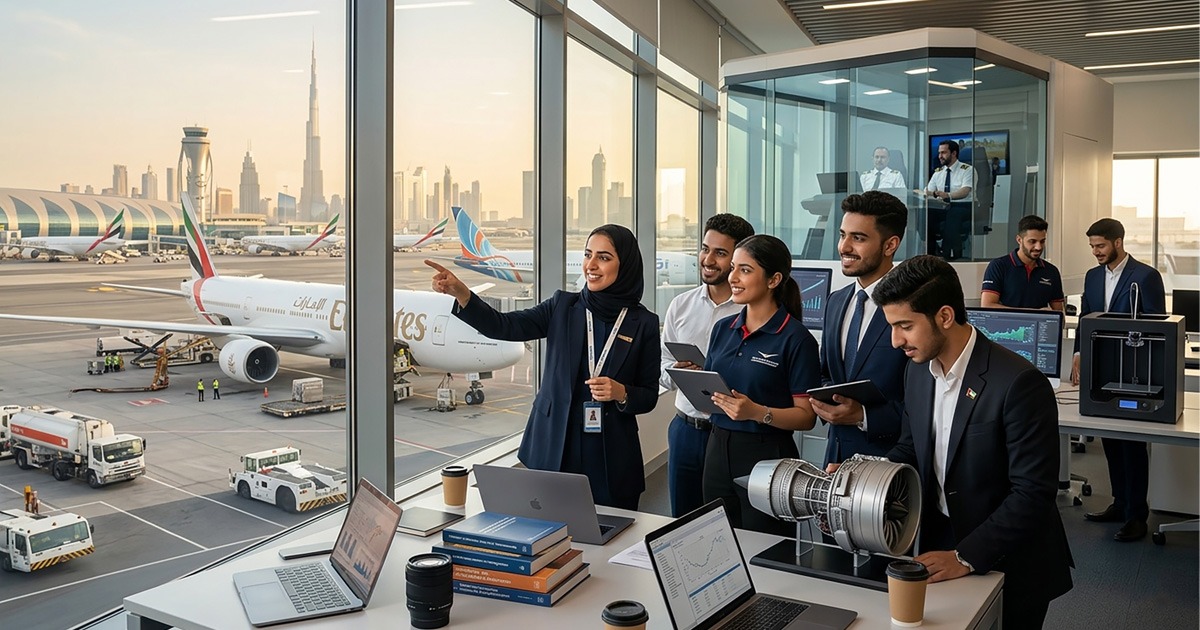
There is a particular kind of pride that comes with watching someone from your own country step into a role that shapes the skies above it. In the UAE, that pride is becoming increasingly common — and increasingly intentional.
Aviation is no longer just a sector where Emiratis work. It is rapidly becoming a sector that Emiratis lead. From the control towers of Dubai International Airport to the safety management offices of Abu Dhabi's sprawling aerospace hubs, UAE Nationals are claiming their place in one of the most technically sophisticated and globally respected industries on earth.
This shift is not happening by accident. It is the result of deliberate national policy, forward-thinking institutions, and a generation of young Emiratis who are ready to rise. If you are a UAE National — or the parent of one — this guide is for you.
The UAE's Emiratization agenda, known formally as the Nafis programme, is one of the most ambitious workforce nationalisation strategies in the world. At its heart is a recognition that the long-term strength of the UAE economy cannot rely indefinitely on imported expertise. The nation must build its own deep bench of skilled professionals — and aviation is among the most strategically targeted sectors.
Why aviation? Because it is mission-critical. The UAE's geography, its global commercial ambitions, and its vision as a future-facing knowledge economy all depend on having a world-class aviation ecosystem. Dubai alone handles over 85 million passengers a year. The UAE has one of the highest concentrations of air routes in the Middle East. To sustain this infrastructure, the country needs its own people trained to the highest international standards.
The General Civil Aviation Authority (GCAA) — the UAE's regulatory body for all civil aviation matters — has taken this mandate seriously. The GCAA has established specific programmes and approval frameworks to ensure that UAE Nationals can enter and advance in technical aviation roles, including air traffic control, aviation safety, flight operations, and ground handling management. These are not token roles. They are the backbone of the entire system.
The strategic goal goes beyond employment numbers. Nationalizing technical roles means building institutional memory — Emirati professionals who understand the specific demands of UAE airspace, who can train the next generation, and who bring national pride and accountability to every decision they make. For UAE high school graduates who are drawn to science, technology, and the idea of a career that quite literally keeps the country moving, aviation offers an extraordinary pathway.
If you want to understand the depth and rigour that governs this pathway, the GCAA-approved aviation courses in Dubai are the clearest starting point. These are not generic training programmes — they are internationally benchmarked, nationally regulated, and designed to produce professionals who can operate in some of the busiest airspace in the world.
One of the biggest concerns for young Emiratis — and their families — when considering an aviation career is cost. Aviation training is not inexpensive. A full pathway from initial training through to a licensed Air Traffic Controller or certified aviation safety professional can require significant investment in both time and money.
The good news is that the UAE has built a rich ecosystem of financial support specifically designed to remove this barrier for nationals.
Government-backed scholarships through entities like the GCAA, Emirates Aviation University, and the Abu Dhabi Aviation cluster provide full or partial funding for Emirati students entering approved aviation programmes. These scholarships often cover not just tuition, but accommodation, living allowances, and international study components.
Airline and airport sponsorships are equally important. Emirates, flydubai, Air Arabia, and Abu Dhabi Airports are among the major aviation entities that operate structured cadet and sponsorship programmes for UAE Nationals. These arrangements typically involve a bond period — the candidate commits to working with the sponsoring organisation for a defined number of years after qualification — which gives both sides security and ensures the investment produces real career outcomes.
National cadet programmes have also emerged as a structured bridge between high school graduation and professional qualification. These multi-year programmes take young Emiratis with the right aptitude and put them through rigorous, internationally recognised training under the guidance of experienced instructors. Participants receive stipends, professional mentorship, and a guaranteed career track upon successful completion.
It is worth noting that these opportunities are not limited to flight operations alone. Aviation is an extraordinarily diverse industry. Some of the most in-demand and well-compensated roles are in air traffic management, aviation safety and SMS, aviation English and communication, and aviation security. Many of these pathways are accessible with a strong high school academic foundation and the willingness to pursue structured professional training.
For those exploring training that aligns with GCAA-recognised standards, courses such as the Train the Trainer programme, the Safety Management System course, and the Aviation English Communication programme each represent specific competency areas where Emirati professionals are increasingly sought after — and where internationally accredited training makes a measurable difference in career progression.
You can also read more about the importance of English language proficiency in this sector in our earlier piece on English language proficiency classes in Dubai, which is a critical gateway skill for many GCAA-recognised roles.
Behind every policy and every training programme, there are real people — Emirati men and women who chose aviation, who put in the work, and who are now building careers that define what national excellence in this industry looks like.
Take the example of UAE National ATCOs who have progressed through the ICAO-compliant ATC pathway and are now managing some of the most complex airspace operations in the Gulf. These professionals started exactly where many readers of this article are — as high school graduates with an aptitude for precision, spatial reasoning, and calm decision-making under pressure. The structured training pathway transformed that raw potential into a licensed, internationally recognised professional competence.
In the safety and compliance space, Emirati safety officers are now leading SMS implementations at major UAE airports and airlines. Many entered the sector through GCAA-approved foundation courses and built their expertise iteratively, combining formal qualifications with on-the-job experience. They are now the people that international airlines consult when operating into UAE airspace. They are the people who train incoming professionals — including expatriates — in UAE-specific regulatory requirements.
The aviation security space tells a similarly inspiring story. UAE Nationals who completed programmes like the Close Protection and Air Marshal Security course or the Level 2 International Award in Security Guarding have gone on to hold senior positions in airport security operations and in-flight safety management. These are roles with real authority and real responsibility — and they are increasingly filled by Emiratis.
These stories matter not just as inspiration, but as proof of concept. The pathway works. The support structures are real. The careers that emerge are prestigious, well-compensated, and deeply meaningful to those who pursue them.
For broader context on how the UAE aviation landscape is evolving — and what it means for those entering it — our blog post on preparing for Dubai's 2026 air taxi revolution paints a vivid picture of just how rapidly this industry is transforming, and why the professionals trained today will be at the forefront of tomorrow's innovations.
ATW Aviation — Air Traffic World — is one of the UAE's most respected aviation training providers, and its commitment to supporting Emiratization is not a marketing message. It is embedded in the structure of what the organisation delivers.
ATW Aviation operates as a GCAA-approved training organisation, which means its courses are not just good — they are formally recognised by the UAE's highest civil aviation authority as meeting the standards required for professional certification and career progression in the national aviation sector. This matters enormously for Emirati professionals and for employers. A qualification from a GCAA-approved provider is not simply a certificate — it is a professional credential with regulatory standing.
The flagship ICAO ATC 051 Basic Induction Course is the entry gateway for aspiring Air Traffic Controllers in the UAE. This programme is delivered both on-site and in structured cohorts, and ATW Aviation has been a central delivery partner for this pathway. For UAE Nationals looking to pursue a career in air traffic management, this is the course that starts the journey. You can explore it in detail here: ICAO ATC 051 On-Site Course.
Beyond ATC, ATW Aviation supports Emiratization through a broader curriculum that addresses the full spectrum of roles in the sector:
ATW Aviation also understands that training alone is not enough. The organisation works closely with employers, GCAA stakeholders, and national development programmes to ensure that its graduates are positioned for real career outcomes — not just certificates. That means career guidance, understanding of the licensing pathway, and a genuine relationship with the aviation community in the UAE.
For Emirati professionals who are curious about what a career in aviation instruction looks like — and why it is one of the most impactful ways to serve the national development agenda — our detailed piece on why the industry needs certified aviation instructors is essential reading.
And for those who want to understand the full scope of what the ICAO 051 course involves and why it matters, our blog on ICAO 051 course requirements and benefits provides a thorough breakdown.
There has never been a better time to be a UAE National with ambitions in aviation. The infrastructure is in place. The financial support is available. The regulatory framework actively champions national participation. And the institutions that deliver world-class training — like ATW Aviation — are ready to walk alongside you every step of the way.
What this moment requires is not luck. It is preparation, commitment, and the decision to take the first step.
Whether you are a high school graduate curious about air traffic control, a young professional looking to formalise your aviation safety credentials, or a seasoned practitioner who wants to become a certified instructor — the pathway exists. The question is simply whether you are ready to walk it.
Explore the full range of aviation courses available at ATW Aviation, or contact the team to discuss which programme aligns with your goals and how to get started.
The next generation of UAE aviation professionals is already in training. Will you be among them?
Ready to take the next step? Visit atw-aviation.com to explore GCAA-approved courses designed for UAE Nationals and professionals across the aviation sector.