There are no items in your cart
Add More
Add More
| Item Details | Price | ||
|---|---|---|---|

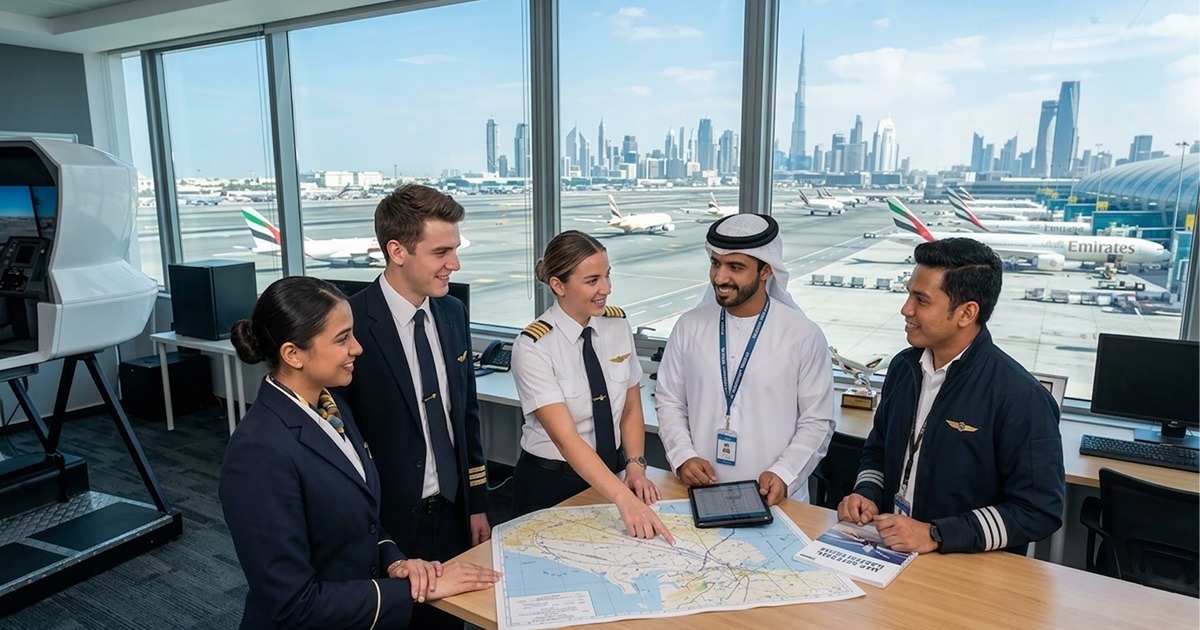
There is a moment that almost every expat professional in Dubai recognises — the moment you realise that the city you moved to for opportunity is not just a stopover. It is a genuine launchpad.
Dubai sits at the intersection of three continents. Its airports handle tens of millions of passengers every year. Its skies are among the busiest on the planet. And its aviation sector — from air traffic control and airline operations to ground handling and safety management — is growing at a pace that few cities in the world can match.
For expats with an interest in aviation, whether you are a recent graduate, a mid-career professional pivoting industries, or a trained specialist looking to formalise your credentials, the UAE offers something rare: a place where internationally recognised training translates directly into local and global career opportunities.
This guide is for you. It walks through why Dubai has become one of the world's most compelling destinations for aviation education, how certifications earned here travel with you across borders, what you need to know about entering the UAE job market as an international candidate, and how to make the connections that actually open doors.
Dubai is not merely a place to study — it is a place to position yourself. That distinction matters more in aviation than in almost any other industry.
Aviation is a regulated, credential-driven profession. The organisations that hire — airlines, air navigation service providers, airport authorities — are not impressed by generic qualifications. They look for training that is delivered under internationally recognised frameworks, validated by the bodies that set global standards, and relevant to the actual operational environments candidates will work in.
Dubai delivers on all three counts.
The UAE's aviation ecosystem is regulated primarily by the General Civil Aviation Authority (GCAA), one of the most respected civil aviation bodies in the Arab world. Courses delivered here and approved under GCAA frameworks are not merely local certificates — they signal alignment with international aviation standards that employers in Europe, Asia, Africa, and the Americas understand and respect.
Beyond regulation, Dubai's position as a global aviation hub means that training happens in proximity to real operations. You are not studying air traffic control theory in a classroom far removed from actual practice. You are learning in a city where Emirates, flydubai, Air Arabia, and dozens of international carriers operate daily, where Dubai International Airport (DXB) is consistently ranked among the world's top airports by passenger volume, and where aviation professionals from across the globe come to work, train, and advance their careers.
For expats, this environment is galvanising. The international character of Dubai's aviation community means that classrooms are diverse, instructors often bring multi-country experience, and the professional networks you build during training are genuinely global in reach.
There is also the matter of practicality. Dubai is one of the most well-connected cities on earth. For expats already based here — whether for work, family, or a previous career — the ability to pursue aviation training without relocating is a significant advantage. ATW Aviation offers programmes that accommodate working professionals, meaning you do not have to pause your life to invest in your future.
And if you are considering the UAE as a destination specifically for aviation education, the lifestyle proposition is hard to argue with. World-class infrastructure, safety, a tax-free income environment, and a business culture that genuinely rewards ambition make Dubai one of the most attractive cities in the world for professional development.
One of the most important questions any expat asks before committing to professional training is: will this qualification work elsewhere?
In aviation, the answer depends almost entirely on the framework under which the training was delivered. Certifications that align with ICAO (International Civil Aviation Organisation) standards — the body that sets the rules for civil aviation globally — carry a level of portability that few other professional credentials can match.
ICAO standards govern everything from air traffic control procedures and language proficiency to safety management systems and training methodology. When a course is delivered according to ICAO frameworks, it is not a local qualification with a local scope. It is a credential that speaks a language recognised by aviation authorities and employers in 193 member states.
ATW Aviation's ICAO ATC 051 course is a direct example of this. Designed in alignment with ICAO Doc 9805 and GCAA TO 105 requirements, this course qualifies graduates for air traffic control assistant roles in the UAE — but its ICAO-aligned curriculum also provides a foundation recognised by aviation authorities in Europe, Asia, and beyond. For an expat who may not spend their entire career in the UAE, that portability is not a bonus feature. It is fundamental.
The same principle applies to CPD (Continuing Professional Development) certifications. CPD accreditation is a quality mark widely recognised across industries and jurisdictions. It signals that a programme meets defined standards for professional development — standards that employers in the UK, Europe, and internationally have learned to trust. ATW Aviation's Train the Trainer course carries CPD accreditation, meaning that an aviation professional who completes it in Dubai can carry that credential into roles in aviation training organisations anywhere in the world.
Language certification is another area where portability is critical. ICAO language proficiency requirements for pilots and air traffic controllers are universal — every ICAO member state requires operational personnel to meet minimum English language standards. ATW Aviation's Aviation English Communication course prepares candidates for ICAO English Level 4 and above, a standard that is not UAE-specific. It is a global benchmark. Achieving it in Dubai means carrying it with you wherever your career takes you.
For expats evaluating training options, the framework is simple: look for programmes aligned with ICAO standards, accredited by bodies such as CPD or Highfield, and approved by GCAA. Certifications that meet these criteria are not limited by geography. They are assets that compound over time, regardless of where your career leads.
Being qualified is not the same as being hireable. For expats entering the UAE aviation job market, understanding how hiring actually works is as important as the certifications on your CV.
The UAE aviation sector is large, diverse, and genuinely open to international talent — but it also has specific expectations, regulatory requirements, and cultural nuances that international candidates need to understand.
Know the regulatory landscape. Aviation roles in the UAE are governed by the GCAA and, for Dubai specifically, the Dubai Civil Aviation Authority (DCAA). Many operational roles require candidates to hold GCAA-approved qualifications. Before applying for roles, ensure your certifications are either GCAA-approved directly or recognised under frameworks (such as ICAO) that the GCAA accepts. This is not bureaucratic complexity for its own sake — it is the baseline that operators use to screen candidates.
Understand the employer landscape. The UAE aviation market includes national carriers (Emirates, Etihad, Air Arabia), airport operators (Dubai Airports, Abu Dhabi Airports), air navigation service providers (such as GCAA's ANS division), ground handling companies, and a growing ecosystem of aviation services and training organisations. Each segment has different hiring patterns, different credential requirements, and different approaches to international candidates.
Tailor your application for the UAE context. UAE employers generally expect a professional profile that is both internationally credible and locally aware. Demonstrating that your qualifications are GCAA-recognised, that you understand the UAE's aviation regulatory environment, and that you have invested in training locally (not just elsewhere) signals seriousness and commitment. Candidates who have completed programmes at ATW Aviation benefit from this — their training demonstrates alignment with UAE standards from the outset.
Consider roles that value international backgrounds. Airlines such as Emirates and flydubai operate global route networks and actively seek staff who bring cultural fluency and language skills. Ground handling and aviation services companies frequently value candidates who have worked across different aviation environments. Your expat background is not a liability — in the right roles, it is a genuine differentiator.
Be strategic about timing. The UAE aviation sector tends to hire in cycles linked to route expansion, fleet growth, and regulatory requirements. Following industry news — through sources such as CAPA - Centre for Aviation — helps you identify when demand is rising and position your applications accordingly.
Finally, do not underestimate the practical dimensions of working in the UAE. Ensure your qualifications are attested where required, that you understand the visa and work permit landscape, and that you have researched salary benchmarks for your target roles. Dubai is competitive, but it rewards those who prepare well.
Credentials open doors. But in aviation — as in most professional industries — it is relationships that determine which doors actually swing open.
Dubai is exceptional for networking in aviation, not because of any single event or organisation, but because of the density of aviation professionals operating in and through the city at any given time.
Dubai Airshow is the most obvious starting point. Held biennially at Dubai World Central, it is one of the largest aviation events on the planet, attracting carriers, manufacturers, regulators, training organisations, and aviation services companies from across the globe. For expats building a career in aviation, attending the Dubai Airshow is not optional — it is essential. The 2025 edition continued the event's tradition of drawing industry leaders across commercial aviation, defence, and emerging technologies such as urban air mobility.
Industry associations and bodies provide more structured networking opportunities. The Arab Air Carriers Organisation (AACO) connects carriers across the Arab world and hosts events that bring aviation professionals together. GCAA and DCAA periodically hold workshops and seminars open to aviation professionals. Engagement with these bodies signals that you take your career seriously and are willing to invest beyond the transactional.
Training cohorts are more valuable than they appear. If you complete a course at ATW Aviation, the professionals you train alongside are not just classmates. They are future colleagues, referrers, and in some cases, the decision-makers who will hire you or recommend you for roles. Aviation in the UAE is a smaller professional community than it might appear from the outside. Investing in relationships during training pays dividends across your entire career.
LinkedIn remains the most practical networking tool for expats in the UAE aviation market. The platform is widely used by UAE aviation professionals, and a well-maintained profile that highlights ICAO-aligned certifications, GCAA-approved training, and specific skills (ATC, safety management, aviation English, cabin crew security) will attract recruiters actively searching for those qualifications. Connect with alumni of ATW Aviation courses, follow GCAA and DCAA pages, and engage meaningfully with content from industry figures.
Language is a competitive advantage. Aviation is an English-language industry at the operational level, but many of the hiring managers and senior professionals in the UAE aviation market also speak Arabic. Expats who invest in functional Arabic — even at a conversational level — send a strong signal about their commitment to working in the region long-term.
You may also find it useful to read our detailed guide on how to become an ATC officer in the UAE, which covers the regulatory pathway from certification to employment in greater depth.
Aviation is one of the most globally mobile careers available. A professional who trains to ICAO standards, earns CPD-accredited qualifications, and builds their network in a hub like Dubai has genuine options — not just in the UAE, but across the industry worldwide.
The UAE offers expats something rare: a combination of internationally recognised training infrastructure, a thriving aviation economy, and a professional environment where ambition is genuinely rewarded. Whether your goal is a role in air traffic control, aviation training, safety management, or airline operations, the foundations you build here will carry you further than you might expect.
ATW Aviation offers a range of GCAA-approved and internationally aligned courses designed specifically for professionals who take their careers seriously. From the ICAO ATC 051 Basic Induction course to the Aviation English Communication programme, Train the Trainer certification, and the Safety Management System course, every programme is built around the standards that matter in the real industry.
Ready to take the next step? Contact ATW Aviation to speak with a training advisor about which programme fits your background and career goals — or browse the full course catalogue to explore your options.
Related Reading: